Handpicked Solfège Books Free. Expert-Tested. Proven.
Every title here has been personally reviewed and handpicked by experienced musicians. These free solfège resources combine theory and ear training with real pedagogical value — no gimmicks, just pure learning.
Why This List Matters
Manually Curated
Every resource was reviewed and handpicked for real-world musical growth.
Instant Access
Download full PDFs — no registration, no waiting, no paywalls.
Trusted Worldwide
Used by educators, choirs, and music students across the globe.
Everything You Need to Know About Free Solfège Books
Unlock your ear training and sight-singing potential without spending a cent. Explore our carefully curated list of top-rated solfège resources available completely free online.
Learning solfège doesn’t have to come with an expensive price tag. Many high-quality materials are freely available, created by professional musicians, educators, and conservatories. We’ve explored hundreds of resources to bring you a definitive selection of the 10 best free solfège books you can download and start using today.
Whether you’re a music student preparing for conservatory exams, a choir member improving pitch accuracy, or a self-taught learner mastering ear training, these books deliver structured, comprehensive lessons for all levels. From classical European methods to modern pedagogical approaches, each title offers something uniquely valuable.
Why These Free Books Stand Out
Quick Comparison Table
Compare all featured solfège books side by side — from beginner-friendly introductions to advanced theory manuals. Quickly spot the best fit for your learning goals, budget, and preferred teaching style.
| Title & Author | Rating | Price | Action |
|---|---|---|---|
| Danhauser – Solfège, Premier Livreby Adolphe Danhauser | ★4.5 | FREE | Get |
| Melodia: A Comprehensive Course in Sight-Singing (Solfeggio)by Samuel W. Cole & Leo... | ★4.6 | FREE | Get |
| Ultimate Guide to Solfègeby Delaware Choral Arts (editor /... | ★4.3 | FREE | Get |
| Solfege Drillsby Francisco Sierra | ★4.1 | FREE | Get |
| Solfege Drills by Daniel Kazezby Daniel Kazez | ★4.0 | FREE | Get |
| Free Singing for Beginnersby Camilla Louise Holmes | ★4.2 | FREE | Get |
| An Aural Approach With Instrumental Music Using Conversational...by Marguerite Wilder & Contributors | ★4.3 | FREE | Get |
| Berklee Online Music Theory: Harmony & Ear Training...by Berklee Online | ★4.6 | FREE | Get |
| Conversational Solfège (Feierabend Method)by Andrew & Jill Feierabend et... | ★4.4 | FREE | Get |
| Music: Teaching Sight Singingby College Board | ★4.2 | FREE | Get |
*All information — including pricing and ratings — reflects the latest verified data from trusted sources.
Complete Book Breakdown
Explore an in-depth look at each featured solfège book — including expert insights, pros and cons, and direct access to the original source or purchase link. Each review highlights what makes the resource valuable for learners at different stages.
Item 1 of 10
Free
Get It NowAuthor: Adolphe Danhauser
Publisher: G. Schirmer, Inc
Level: Beginner
Format: PDF (66 pages)
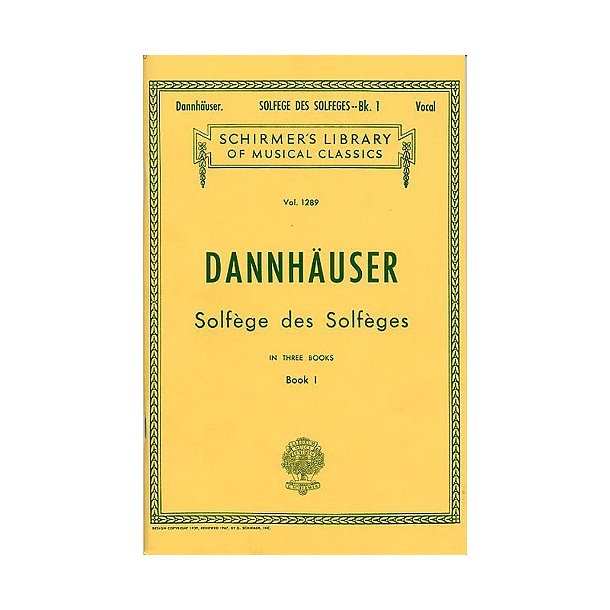
Danhauser – Solfège, Premier Livre
4.5 ★The 'Solfège des Solfèges, Premier Livre' by Adolphe Danhauser is one of the most well-known introductory methods for music students. It contains progressive exercises for sight-singing, rhythm, and intonation. Each exercise is carefully designed to build a strong foundation in music reading and ear training, making it easier for students to understand melodies and harmonies.
Key Benefits:
- ✓ Progressive beginner exercises
- ✓ Supports ear training & rhythm study
- ✓ Foundational text for classical training
- ✓ Free public domain PDF
Considerations:
- ✗ Old-style notation may feel outdated
- ✗ Limited to beginner focus
Item 2 of 10
Free
Get It NowAuthor: Samuel W. Cole & Leo R. Lewis
Publisher: Oliver Ditson Company
Level: Beginner to Advanced
Format: PDF (216 pages)
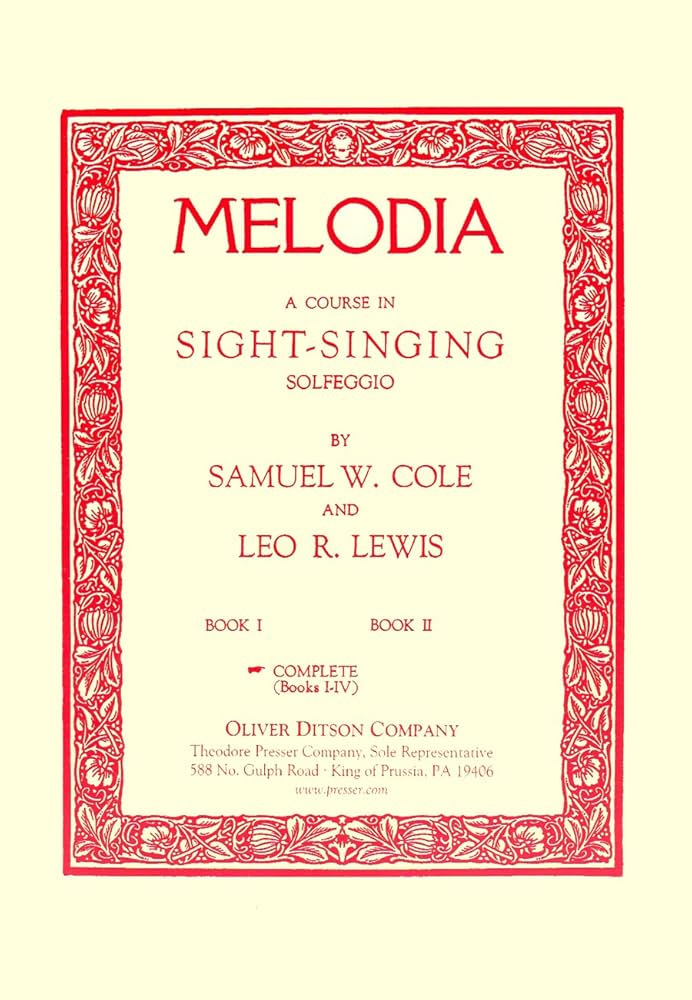
Melodia: A Comprehensive Course in Sight-Singing (Solfeggio)
4.6 ★“Melodia: A Comprehensive Course in Sight-Singing (Solfeggio)” by Samuel W. Cole and Leo R. Lewis is a foundational music education text first published in 1904. Designed to develop a singer’s ability to read and perform music at first sight, the method emphasizes building confidence through progressively challenging exercises. The course is divided into four books, each focusing on different aspects of vocal training, including interval reading, rhythmic accuracy, and solfège practice.
Key Benefits:
- ✓ Structured progressive exercises in sight-singing
- ✓ Divided into volumes to match learner progression
- ✓ Free public domain educational resource
- ✓ Used in music education courses
Considerations:
- ✗ Older style / notation
- ✗ May require guidance or supplementary material
Item 3 of 10
Free
Get It NowAuthor: Delaware Choral Arts (editor / publisher)
Publisher: Delaware Choral Arts
Level: Beginner to Intermediate
Format: PDF (12 pages)
Ultimate Guide to Solfège
4.3 ★The “Ultimate Guide to Solfège” PDF offers a modern introduction to solfège, its benefits, and its methods in vocal and general music training. It serves as a practical reference for singers, educators, and music students. By incorporating this volume into regular practice, musicians can develop a stronger sense of pitch and rhythm, essential components of musical mastery. The guide is freely available from the Delaware Choral Arts organization.
Key Benefits:
- ✓ Straightforward guide to solfège practice
- ✓ Useful for singers and choir training
- ✓ Free public domain style PDF from an educational institution
Considerations:
- ✗ Not a traditional method book
- ✗ Less musical exercises than classic method texts
Item 4 of 10
Free
Get It NowAuthor: Francisco Sierra
Publisher: Francisco Sierra
Level: Beginner to Intermediate
Format: PDF (29 pages)
Solfege Drills
4.1 ★Francisco Sierra’s Solfege Drills is a practical resource designed to enhance musicians' sight-singing and ear-training skills. This collection offers structured exercises focusing on intervals, scale patterns, and solfège syllables, making it ideal for daily practice. The drills are organized to reinforce fundamental concepts, aiding musicians in developing a strong aural foundation.
Key Benefits:
- ✓ Structured interval & scale drills
- ✓ Free public PDF resource
- ✓ Supplemental for solfège curriculum
Considerations:
- ✗ No publisher info
- ✗ May not stand alone as a full method
Item 5 of 10
Free
Get It NowAuthor: Daniel Kazez
Publisher: Journal of Music Theory Pedagogy
Level: Beginner to Intermediate
Format: PDF / article (17 pages)
Solfege Drills by Daniel Kazez
4.0 ★“Solfege Drills” by Daniel Kazez is a practical guide to enhancing musicianship through targeted solfège exercises. Published in the Journal of Music Theory Pedagogy (Vol. 6, 1992), the article offers a structured approach to ear training and sight-singing. Kazez's drills are designed to improve pitch recognition, interval identification, and rhythmic accuracy, making them valuable tools for both students and educators. The exercises cater to various skill levels, providing a progressive framework that supports the development of aural skills and theoretical understanding
Key Benefits:
- ✓ Targeted solfège drills
- ✓ From a pedagogical journal, suitable for educators
- ✓ Free academic resource
Considerations:
- ✗ Not a full method book
- ✗ Primarily academic / article format
Item 6 of 10

Free
Get It NowAuthor: Camilla Louise Holmes
Publisher: Camilla Holmes
Level: Beginner
Format: PDF (41 pages)
Free Singing for Beginners
4.2 ★Camilla Holmes' Free Singing for Beginners is a practical guide designed to help new singers build a strong foundation. The book covers essential topics such as warm-ups, breathing techniques, and basic music theory, making it accessible for those starting their vocal journey. Holmes emphasizes the importance of proper posture, voice care, and consistent practice to develop vocal strength and flexibility.
Key Benefits:
- ✓ Practical singing exercises and vocal tips
- ✓ Designed for beginners to start singing safely
- ✓ Includes theory basics to support singing
Considerations:
- ✗ Not a full method text
- ✗ Simpler content, may lack advanced depth
Item 7 of 10
Free
Get It NowAuthor: Marguerite Wilder & Contributors
Publisher: GIA Publications
Level: Intermediate
Format: PDF (16 pages)
An Aural Approach With Instrumental Music Using Conversational Solfège
4.3 ★This is a pedagogical method linking ear training, singing, and instrumental musicianship. It emphasizes learning music through listening and internalizing patterns before reading notation. The method is based on the Conversational Solfège approach developed by Andrew and Jill Feierabend, which focuses on developing musical literacy through tonal and rhythm patterns.
Key Benefits:
- ✓ Bridges between listening and performing
- ✓ Supports conversational solfège pedagogy
- ✓ Free access for music educators and students
Considerations:
- ✗ May require teacher guidance
- ✗ Some instrumental content may be advanced
Item 8 of 10

Free
Get It NowAuthor: Berklee Online
Publisher: Berklee Online
Level: Intermediate / Advanced
Format: PDF (72 pages)
Berklee Online Music Theory: Harmony & Ear Training Handbook
4.6 ★This handbook from Berklee Online provides a strong foundation in harmony and ear training, linking theoretical concepts with listening exercises. Freely downloadable from Berklee’s site. It covers scales, intervals, chord progressions, and practical ear training techniques used in contemporary music education. The handbook is designed to support students in developing aural skills alongside theoretical understanding, making it a valuable resource for musicians looking to enhance their musical literacy.
Key Benefits:
- ✓ Integrates theory with ear training
- ✓ Covers harmony, scales, intervals, chord progressions
- ✓ Authoritative source from Berklee
Considerations:
- ✗ Not a full textbook
- ✗ May require supplementary exercises or practice software
Item 9 of 10

Free
Get It NowAuthor: Andrew & Jill Feierabend et al.
Publisher: Feierabend / GIA Publications
Level: Beginner to Intermediate
Format: PDF (23 pages)
Conversational Solfège (Feierabend Method)
4.4 ★‘Conversational Solfège’ is a program by Feierabend that introduces musical literacy using tonal and rhythm patterns before notation. The method encourages internal hearing, pattern singing, and gradual exposure to notation. The PDF is hosted via GIA’s site. It is designed for second through eighth grade general music programs, helping students become independent musical thinkers through engaging literature and aural skills development.
Key Benefits:
- ✓ Bridges aural and notation skills
- ✓ Progressive pattern-based learning
- ✓ Widely respected in music education communities
Considerations:
- ✗ Not a full textbook for advanced musicians
- ✗ May require structured teaching guidance
Item 10 of 10
Free
Get It NowAuthor: College Board
Publisher: College Board
Level: Intermediate / Educational
Format: PDF (58 pages)
Music: Teaching Sight Singing
4.2 ★This College Board guide “Music: Teaching Sight Singing” offers pedagogical strategies, exercises, and theory for teaching sight singing in schools and institutions. The full PDF is hosted on College Board’s site. It emphasizes developing musicianship skills through structured sight-singing exercises, ear training, and music theory. The guide is intended for educators looking to implement effective sight-singing instruction in their curriculum.
Key Benefits:
- ✓ Teacher-centric guide with exercises
- ✓ Structured approach for classroom instruction
- ✓ Free download from authoritative source
Considerations:
- ✗ Focused on pedagogy (teachers)
- ✗ Not a full student method book
How to Get Started
Choose Your Level
Browse the comparison table and pick a book that matches your current skill level. Beginners should start with foundational methods, while advanced students can jump to more complex materials.
Download & Print
Click the download link in each book's review section. Save the PDF to your device or print it for traditional practice. All books are completely free with no registration required.
Practice Daily
Consistency is key! Set aside 15-30 minutes each day for solfège practice. Work through exercises methodically, and don't rush. Record yourself to track progress.
Progress & Advance
As you master each book, move to the next difficulty level. Consider working through multiple books simultaneously for a well-rounded approach.
How to Choose the Right Solfège Book for Your Level
Not all solfège books are created equal. Understanding your skill level, preferred learning system, and teaching approach will help you select the perfect resource for your musical journey.
Beginner vs. Intermediate vs. Advanced Criteria
Choose materials that match your current abilities and challenge you appropriately.
🌱 Beginner
- •Simple melodic contours: Primarily stepwise motion and small leaps
- •Diatonic focus: Major scales without many accidentals
- •Basic rhythms: Whole, half, and quarter notes in simple time
- •Short exercises: Manageable lengths to build confidence
- •Clear key center: Strong emphasis on tonic (Do)
📈 Intermediate
- •Expanded keys: Wide range of major and minor key signatures
- •Complex rhythms: Dotted rhythms, syncopation, varied meters
- •Larger leaps: Arpeggios and challenging intervals
- •Chromaticism: Introduction of accidentals and altered tones
- •Harmonic awareness: Recognition of chord progressions
🎯 Advanced
- •Extensive chromaticism: Complex dissonance and altered intervals
- •Advanced modulations: Rapid shifts between distant keys
- •Complex meters: Irregular and mixed time signatures
- •Multi-part exercises: Canons, duets, and ensemble work
- •Expressive nuance: Dynamics, articulation, and phrasing
Fixed-Do vs. Movable-Do Considerations
Understanding the two main solfège systems will help you choose books aligned with your learning goals.
Fixed-Do System
Each syllable is permanently assigned to a specific pitch (Do = C, Re = D, etc.), regardless of key.
✓ Best For:
- • Absolute pitch development
- • Atonal or contemporary music
- • Orchestral musicians needing pitch precision
- • Students from Romance/Slavic language backgrounds
⚠ Limitations:
- • Less helpful for understanding tonal relationships
- • Can be cumbersome with frequent key changes
- • Requires strong absolute pitch or acts as another naming system
Movable-Do System
RECOMMENDEDSyllables represent scale degrees relative to the key (Do = tonic), emphasizing functional relationships.
✓ Best For:
- • Developing relative pitch and ear training
- • Understanding tonal relationships
- • Sight-singing and transposition
- • Improvisation and playing by ear
- • Most learners focused on tonal music (30% better pitch recognition)
💡 Key Benefit:
Cultivates deep understanding of how notes function within keys, making it easier to recognize patterns across all keys.
Expert Tip: For most musicians, especially those focused on tonal music and developing strong ear training skills, movable-do offers more practical benefits and cultivates a deeper understanding of musical structure.
Classical vs. Modern Pedagogical Approaches
Different teaching philosophies offer unique benefits depending on your learning style and goals.
Classical Approaches
Traditional methods rooted in European conservatory training, dating back to Guido d'Arezzo (11th century).
Key Characteristics:
- ▸Structured progression: Highly sequential, systematic exercises
- ▸Notation-focused: Emphasis on reading traditional staff notation
- ▸Theoretical foundation: Often separates theory from practice
- ▸Rigorous training: Extensive sight-singing and dictation drills
Best for:
Students preparing for conservatory exams, classical musicians, and those who prefer traditional, discipline-focused learning.
Modern Approaches
Contemporary methods integrating psychology, child development, and holistic musicianship (Kodály, Dalcroze).
Key Characteristics:
- ▸"Sound before sight": Aural skills developed before notation
- ▸Multi-sensory learning: Combines singing, movement, and visual aids
- ▸Practical musicianship: Focus on playing by ear and improvisation
- ▸Engaging strategies: Games, call-and-response, interactive exercises
Best for:
Self-taught learners, younger students, musicians focused on contemporary genres, and those who prefer interactive, holistic learning.
🎓 Classical Example:
"Solfège des Solfèges" by Dannhäuser — systematic, notation-heavy exercises progressing from simple to complex.
🎨 Modern Example:
Kodály-based materials — folk songs, hand signs, and movement integrated with solfège training.
Making Your Choice
The best solfège book for you depends on your current skill level, learning goals, and preferred teaching style. Consider these factors:
Assess your level — Start with beginner materials if you're new to solfège
Choose your system — Movable-do for most learners, fixed-do for specific needs
Match your style — Classical for structure, modern for engagement
Start Learning Today—Free!
With 10 professional books at your fingertips, there's no better time to begin your solfège journey. Download, practice, and grow—all at zero cost.
View The Best BooksRelated Articles
Continue exploring our solfège resources
Top Solfège Books 2025
Discover the highest-rated solfège books of 2025, expertly reviewed and ranked for quality and effectiveness.
Best Solfège Books Under $20
Find budget-friendly solfège books that deliver exceptional value without compromising on quality.
Best French Solfège Books
Explore authentic French solfège methods from renowned conservatories and music educators.